





Bone broth - a true blessing for my body
As someone with Crohn's disease, my daily cup of bone broth brought me significant physical improvement within just 2 weeks. Soothing and very easy on the stomach. Shipping is super fast. Many thanks! :)

Based on 1,182 real reviews from
36,236+ happy customers
Halloween 2026
Our spookily good-value Halloween bundles are only available until the end of this week!
As someone with Crohn's disease, my daily cup of bone broth brought me significant physical improvement within just 2 weeks. Soothing and very easy on the stomach. Shipping is super fast. Many thanks! :)

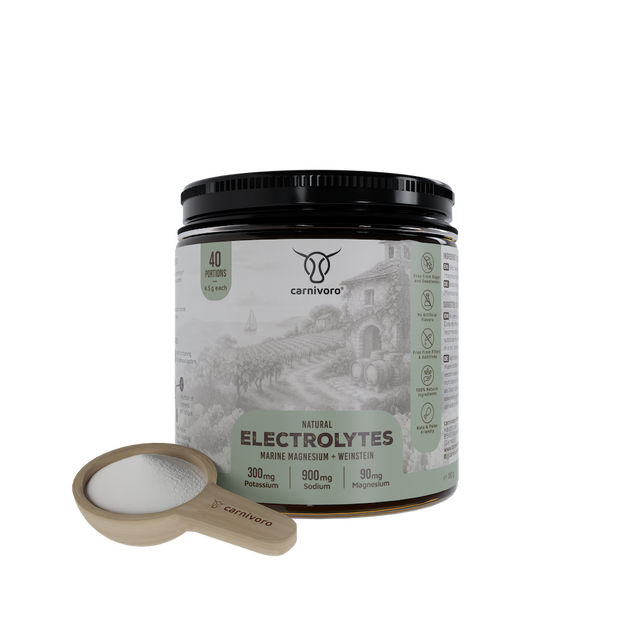
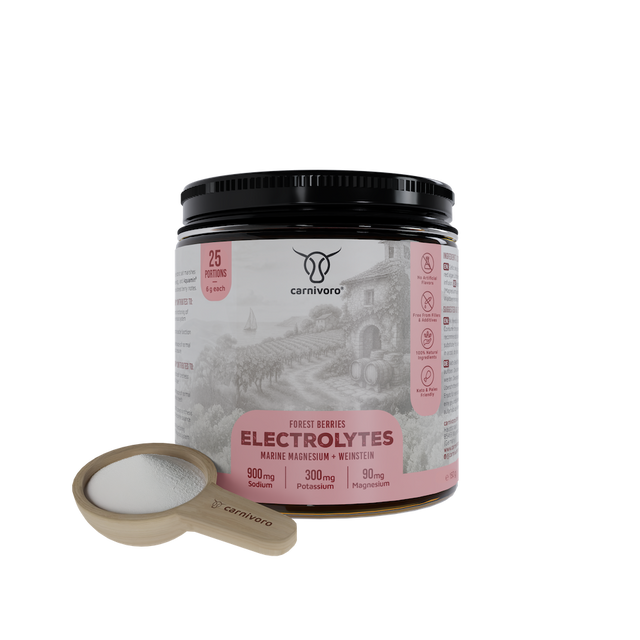
I searched forever for an electrolyte mix without sugar, sweeteners and the like. Everything felt either way too sweet, too chemical or just plain disgusting. Thank you for finally answering my prayers :D Slightly tart taste, not intrusive and not too salty either. Every morning I mix half a scoop into about 700 ml of cold sparkling water. For me the taste is first-rate.

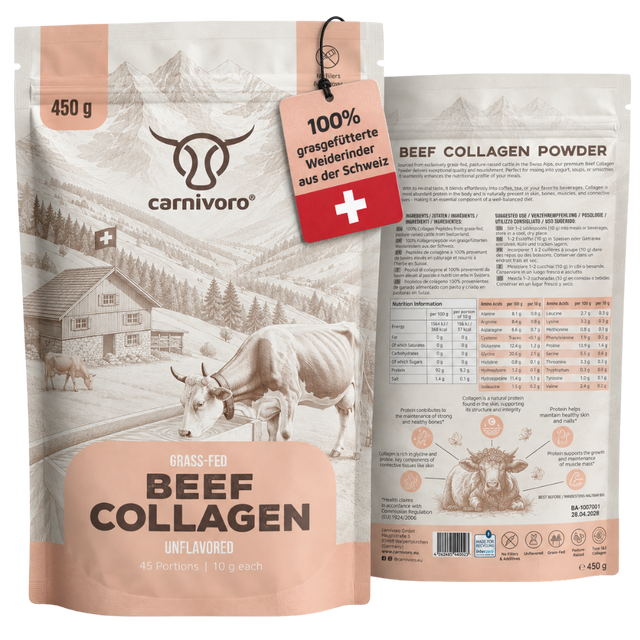
I am very happy with the Beef Collagen and will keep ordering it. It is taste-neutral and dissolves well. I had knee pain for quite a while, and after taking the collagen it vanished as if by magic :)

Years of vegetarianism pushed my body to its limits. I have been lacking countless minerals and trace elements for years, and supplementation brought only minor improvements. I am constantly tired and drained, my hormone balance is out of whack, I am always cold, and I just cannot get rid of my pimples. I came across these capsules, and after just two weeks of taking them I can see and feel clear improvements (no new pimples are appearing, and I always feel pleasantly warm)! It is a fantastic product and I will definitely reorder it.

It smells very pleasant, absorbs very quickly, and has a very good effect on the skin. The skin on my shins is often very itchy and sensitive, and I have very dry patches on my knees. Since I started using this cream, everything is significantly better, even after only using it occasionally. It also feels very pleasant on the face.

I am new to the carnivore way of eating and do not like organ meats. But I know how important they are, so I am very grateful that I can now take them in pill form. Necessary and effective.

On the recommendation of a Carnivoro team member, I switched from magnesium citrate to magnesium glycinate and started taking 200 mg before bed. My sleep quality is clearly better and I no longer get twitches as I fall asleep. Thank you for the patient and competent advice on the phone. Will order again.

I had surgery for stomach cancer 7 years ago and often have stomach trouble after eating (pressure and a feeling of fullness). I take 2 Gallmet and after a few minutes it gets better. My wife and I can only recommend Gallmet.

I have been taking Beef Testicles for a while now and recently added Beef Liver. I feel great and would not want to be without either of them. A must for every man.

I started taking Goddess when I was five months pregnant and severely anemic. My iron levels were so low that doctors wanted to give me a blood transfusion. Goddess was one of the supplements I took daily to raise my iron levels. I continued taking it throughout and after my pregnancy. Having been anemic my whole life, it's a product I wish I'd had much sooner! At delivery, my iron levels were the best I've ever had in my medical history. I recommend this product to all women, especially those with iron deficiency or who are pregnant or breastfeeding, to strengthen their blood and keep both mom and baby strong. I also appreciate the high quality of this product. It's important to me to know that I'm buying pure, ethical, and clean products.

The deodorant cream is super easy to apply and leaves a lovely scent. At the same time it feels very pleasant and nourishing. Highly recommended!
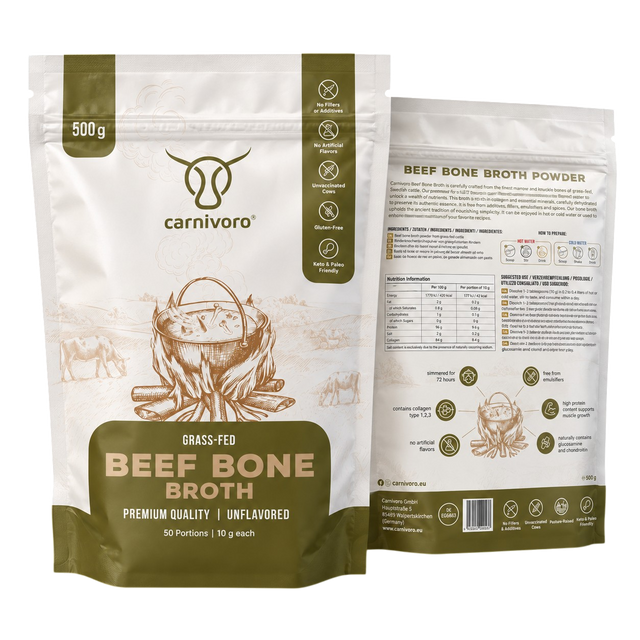
We drink Carnivoro's bone broth every day because it is important for skin and joints. Neutral in taste - my wife takes it straight with hot water, I have it with raw cacao, raw milk and a spoonful of good coconut oil in the tradition of Aajonus von der Planitz. Mmmh.
Every day I drink my favorite tea and Carnivoro collagen powder. I tried other brands, but the production or origin was always so unclear. Since I started taking Carnivoro's collagen, my skin has gotten noticeably better, my hair has grown quickly, and more. I will always order from you.

Hi, I'm really happy with the product and will definitely reorder. I've been taking beef liver capsules since September, I just had a different supplier before. Since moving to Germany a few months ago, I'm very glad... carnivoro I've found it. I feel really good and full of energy, and I can clearly feel the difference since I started taking the beef liver capsules.
The best facial care my skin has ever had. Especially now in the cold weather, with heated rooms, my skin feels very supple. No redness or dry skin. I am very happy to recommend it.
The quality is truly top-notch. I feel much fitter and have noticed that my hair and eyelashes have grown back much stronger. My histamine issues have also improved. Never again without it!
If I accidentally eat too much fat (which has actually happened a few times now) and feel nauseous, a single capsule helps within a very short time. Highly recommended for everyone. Carnivore Especially beginners!

Since I have very dry facial skin, this cream is wonderful. It feels very pleasant on the skin, absorbs well, and the skin feel is great. I really like the scent of lavender and rose. I tried the 30 ml to test it, it won me over, and next time I will get the 100 ml.
Beef liver delivers real retinol, the active form of vitamin A. Carrots, by contrast, only provide beta-carotene, which your body converts only poorly.
Beef liver delivers heme iron. The form your body absorbs 5x better than plant-based iron. Oxalic acid in spinach makes absorption even harder.
Copper is iron's silent partner. Without copper, your body cannot properly use iron. Beef liver is one of the best natural sources of copper.
One daily portion of beef liver delivers 8.5 µg of vitamin B12. As much as a 340g steak. And that even though beef is already considered one of the best B12 sources!
Choline is essential for brain and liver function, one of the most frequently overlooked nutrients. Plant sources provide hardly any. Beef liver is one of the densest natural choline sources of all.
can't utilize it! Up to 80% of synthetic folic acid from tablets or plant sources remains unused in the blood and is not absorbed.
intact. When searing or cooking meat or organs, heat-sensitive vitamins such as folate, thiamine and B6 are lost. Pan-fried liver contains up to 50% fewer vitamins.
of fresh beef liver without the acquired taste. For everyone who appreciates the benefits of beef liver, but not the taste!

Optional — skip if you prefer to see your results right away.

Medical physicist and naturopath
An animal-based diet is the original, species-appropriate diet for humans. Animal foods such as meat and organ meats are the true superfoods and can be produced regionally all year round.

Specialist in anesthesiology
Many modern chronic diseases originate in the gut. A carnivore diet fights the cause of gut problems directly at the root rather than just treating the symptoms, which can lead to a lasting improvement in quality of life.

Specialist in general medicine
Fasting is the oldest remedy in the world and the mother of all elimination diets. But in a hectic everyday life, longer fasting is often hard to put into practice. This is exactly where the carnivore diet comes in for me: it works like a gentle, everyday-friendly form of fasting.
9 years of ulcerative colitis, countless medications, and one decision that changed everything for me.


"Diet plays no role in your condition." Those were the words of my doctor at the time...
That was me at 22: puffy face and red skin from the cortisone. Yet still constant diarrhea, sweating episodes, underweight.

Mesalazine daily, TNF-alpha blockers (infliximab) every 8 weeks, azathioprine at times. Prednisolone for acute flare-ups and Cortiment for "vacation".
For years I took a medication cocktail whose long-term effects are barely foreseeable, with a list of side effects that makes you feel sick just reading it.

After 9 years of medication, I turned my diet upside down overnight: meat, organs, eggs, bone broth and salt. Nothing else!
After less than 3 months my symptoms were gone. My inflammation markers fell into the normal range. For the first time since my diagnosis, I felt healthy!

No vegetables, no fruit, no carbohydrates! After two years of carnivore eating I was barely recognizable and won my first competitions.
In this photo I weighed just under 90 kg. During my immunotherapy I was clearly underweight, tipping the scales at only 77 kg

Completely unexpectedly, we relegated the reigning Hyrox world champions to 2nd place with a 4-second lead. That's what can happen when you believe in yourself more than in your doctor's opinion ;)
Between 2021 and 2025 I took part in 15 Hyrox races and stood on the podium 13 times. 3 times as overall winner and 8 times as winner of my age group in Hyrox PRO.

Anger that for years I was told diet played no role. Joy about what is possible when you believe in yourself instead of letting others push you into a victim role.
Originally, carnivoro was only meant to be a blog where I would document my journey and help people in similar situations.
Today it is my passion project and I am grateful every single day for being in direct contact with you, whether by email or on the phone!
And I am just one of thousands of people who managed to get their chronic condition under control through truly nutrient-dense, low-inflammation eating.

Personal experience report. Not medical advice. Talk to your doctor before making changes to your diet or medication.
Want to go deeper?
This story is not a one off. More and more people are finding that chronic health is not a matter of chance but a skill. For everyone who wants to go further than nutrition, there is a next step.

Over more than 15 years in professional sport, Dr. Gerrit Keferstein experienced the healing power held in species appropriate food, breathing, movement, mindset and natural forces such as sunlight. Out of this came the CHRONISCH GESUND model: a 16 month training programme in which former patients, coaches, trainers, therapists and doctors become professional mentors for chronic health.

Individual guidance from our team of doctors, therapists and nutrition experts. For people who want more than just supplements.
Everything worth knowing about our products, where they come from, your order and the carnivore diet.
If you eat organs regularly, there is most likely no need to additionally take freeze dried organ capsules.
Our products (such as our Beef Liver capsules) are mainly intended for people who do not want to prepare organs themselves on a regular basis or cannot get used to the taste.
Beef organs (liver in particular) contain more vitamins and minerals per gram than any other food, with particularly high bioavailability.
Gentle freeze drying preserves around 95% of all nutrients in the organs. That is considerably more than with conventional preparation methods (frying, roasting or boiling).
On a classic carnivore diet limited to muscle meat and salt, nutrient deficiencies are unfortunately not rare. Muscle meat contains only very low concentrations of vitamins A, C, E, B5 and B9 (folate). Supplying the body with the minerals calcium and magnesium and with trace elements such as manganese, fluoride and iodide is also difficult when you eat meat alone.
Especially on the classic, strictly restrictive version of the carnivore diet, adding certain supplements can be particularly useful. We have gathered the most important supplements for a classic carnivore diet for you in our carnivoro guide.
In a "nose-to-tail" carnivore diet, all parts of the animal are eaten as a matter of principle, to make sure all important nutrients are consumed.
This type of carnivore diet is believed to most closely reflect the diet of our early ancestors.
A "nose-to-tail" diet is particularly rich in vitamins and important protein complexes such as collagen, which often fall short in a conventional diet.
If you don't want to miss out on the benefits of a "nose-to-tail" diet but cannot get used to eating organs and collagen-rich cuts of meat, the best option is to supplement with beef liver capsules and beef bone broth.
The shell of our organ capsules is made of pure beef gelatine, which fits an animal based diet. We deliberately do without plant based cellulose shells and without fillers. Products in powder form need no capsule at all.
Yes, our products are designed to complement each other. If you are unsure which combination suits your daily routine, write to us or use our product finder. When taking them, follow the recommendation on the respective product page.
Pregnancy and breastfeeding are special phases. Please speak with your doctor before taking them, so you can decide together what is right for you.
Our products and serving recommendations are developed for adults. Offal is a traditional food and has always had its place in children's diets too. Whether and in what amount a food supplement makes sense for your child is something you are best off discussing with your paediatrician beforehand. Products with a hormonal connection such as Beef Testicles are not intended for children.
If you take medication long term, please discuss taking them with your doctor beforehand. That way you are on the safe side.
Based on the current state of research, there is no reason to assume that eating red, unprocessed meat increases the risk of cancer.
You will find a detailed article on why this is not the case in our guide.
Gout is a metabolic disease in which excess uric acid is deposited in crystalline form in the joints. Because meat and organs contain purines, the precursor of uric acid, gout patients are usually advised to follow a low purine diet.
Current research shows, however, that uric acid levels are influenced by diet by only 14 to 16 %, and that gout patients often have a genetic predisposition. The biggest risk factors for a gout attack are not meat or organs but excess weight, heavy alcohol consumption and fructose.
Worries about developing gout through a strict carnivore diet without fructose and alcohol are unfounded.
You will find the best before date on every pack. Our products are best stored dry, cool and protected from light. Keep powders and capsules tightly closed after opening.
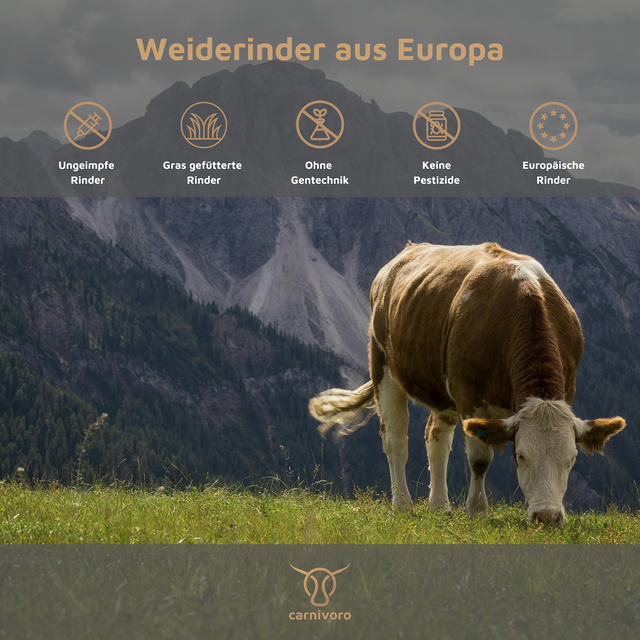
Our raw materials come from genuine pasture farming and near-natural production in Europe. Depending on the product they come from different regions, for example from Swedish pasture raised cattle. This origin is the basis for the quality you taste and feel in every product.
Not because German grass-fed beef is bad in principle, but because we make no compromises on origin. Our raw materials come from Sweden, Estonia and Switzerland. These regions have two advantages: for geological reasons their soils are naturally less contaminated with heavy metals, and their pastures are farmed far less intensively and with less industrial fertiliser than many areas in densely populated industrial regions. What the animal takes in through grass and soil is later found in the product. For us, quality therefore does not begin in the laboratory but on the pasture. We test all the same: independent laboratories check our products for heavy metals among other things.
Meat, organs and products from grass-fed animals contain higher concentrations of the healthy omega-3 fatty acids ALA, EPA, DHA and DPA.
While the difference in muscle meat is comparatively small, organs from grass fed animals often contain 20 to 100 times the concentration of omega 3 fatty acids.
Microbial load is also considerably lower with grass feeding and pasture farming than with conventional forms of husbandry.
Because transparency is part of honesty for us, and because many of our customers deliberately want to know how the animal their product comes from lived. Unvaccinated animals from near natural pasture farming are part of our aim to stay as close as possible to original, species appropriate animal husbandry. You decide what matters to you. We make sure you get the information about it.
Our supplements are tested by independent laboratories, for heavy metals and microbes among other things. That way we make sure what is inside is what is on the label, and nothing that does not belong there.
No. Our products come exclusively from stunned animals raised on European pasture. We reject slaughter methods without stunning on principle for animal welfare reasons, including within religious rules.
Within Germany your order usually reaches you in 1 to 3 business days. Deliveries abroad mostly take a few business days longer. We ship as soon as your order reaches us.
Within Germany we deliver for a flat €3.99, free of shipping costs from €60 order value. To Austria and the rest of the EU we deliver for a flat €9.99, free of shipping costs from €150 order value. For Switzerland and the United Kingdom, customs duties and import taxes may also apply. You can see the exact costs transparently in the cart.
We deliver within Germany, to most of the EU and to Switzerland and the United Kingdom. You can see the options and costs available for your country directly at checkout.
As soon as your parcel leaves our warehouse, you get a shipping confirmation by email with your tracking history. With it you can follow your delivery at any time.
You can pay conveniently with PayPal, Klarna, Apple Pay, Google Pay and with the usual credit and debit cards (including Visa, Mastercard and American Express). All payments are encrypted and secure.
Yes, with Klarna you can pay later or in instalments depending on availability and take your time trying your product first. You will automatically see which options are available for your order at checkout.
Yes. With our products you get a bulk advantage when you buy several units at once. That way you stay supplied for longer and save per unit. You can see the advantage directly on the product page.
You can withdraw from your purchase and return unopened, originally sealed products within 14 days. Once the seal on foods and supplements has been opened, a return is excluded by law for reasons of hygiene and health protection. In the case of transport damage or a mistake on our side, just get in touch and we will find a solution.
Your satisfaction matters to us. If you have questions you can reach us at any time at support@carnivoro.eu, and we usually reply within 24 hours.

